
A recent survey of Hispanic families provides an important window into how Latino households choose their children’s schools and what skills they hope their children gain from education. According to the survey, conducted September 2-3, 2022 by Conoce tus Opciones Escolares, more than half of Hispanic parents said that they are considering, or have considered in the last year, choosing a new school for at least one of their children.
The survey consisted of 19 questions covering K-12 education topics. Respondents included 1,228 parents (of children between ages 5 and 18 years old) who self-identified as Hispanic or Latino. No mention of Conoce tus Opciones Escolares or School Choice Week was made to prevent bias.
Key Findings
Hispanic and Latino parents were more likely than their non-Hispanic and Latino peers to consider new schools for their children.
Amidst persistent achievement gaps and widespread pandemic-related disruptions to K-12 education, Hispanic and Latino parents in the U.S. were more likely than their non-Hispanic and Latino peers to exercise the school choice options available for their children.
According to our survey, 59% of Hispanic and Latino parents considered finding a new or different school for at least one of the children in their household within the past twelve months. Comparatively, a January 2022 NSCAF survey included the same question, and 52% of all parents, including Hispanic and non-Hispanic respondents, had been or were considering new schools.
56% of Hispanic and Latino parents were motivated to search for new schools because of a desire for higher quality education, 49% listed concerns over school safety and bullying as a motivation, and 49% were motivated by the effects of the pandemic on their children’s education.

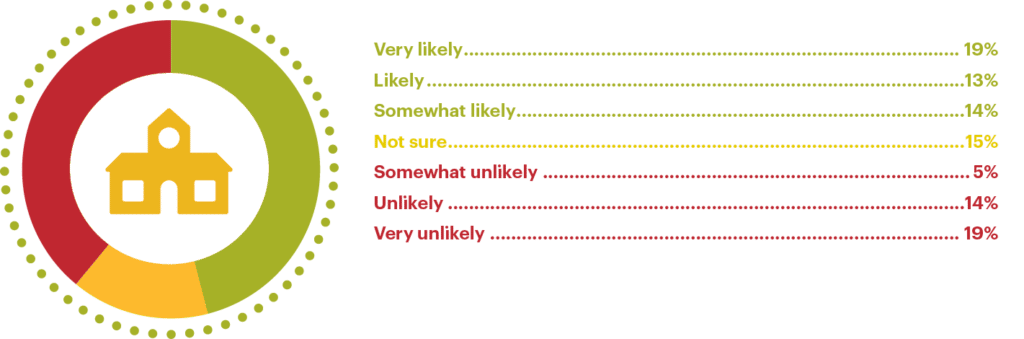
Nearly half of Hispanic and Latino parents said they were likely to consider a new or different school for their children for the 2023-2024 school year.
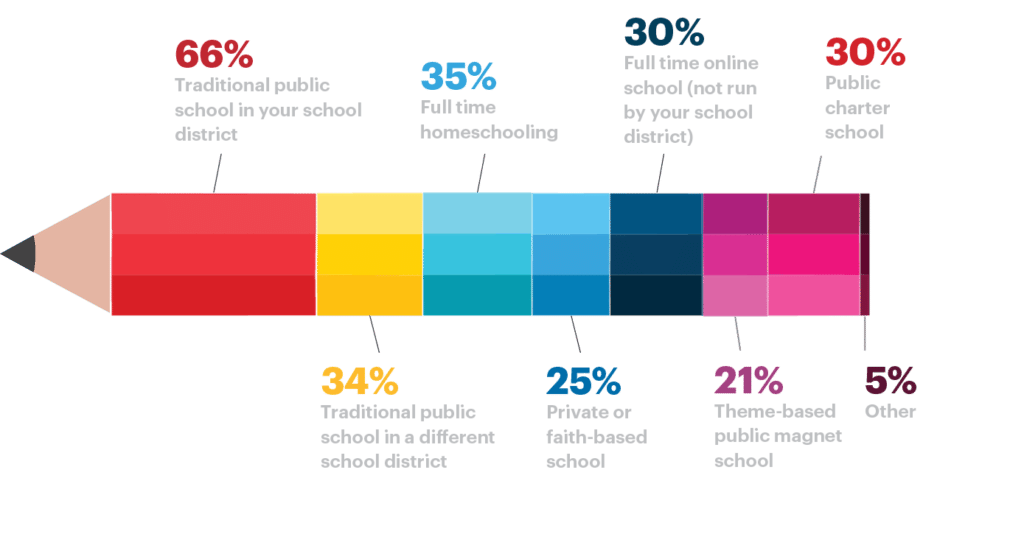
In exercising their school choice options, Hispanic and Latino parents were interested in a broad range of school types, including traditional public schools.
Debates over K-12 school choice policy too often reduce school choice to a simple proposition: public vs. private. In reality, the landscape of education options is much more diverse.
According to our survey, Hispanic and Latino parents were willing to consider a variety of schooling options for their children. Specifically, 34% said they did or might choose a traditional public school in another school district, 35% expressed an interest in homeschooling, 30% would consider full-time online schooling or charter schools, 24% expressed interest in private schools, and 21% would consider magnet schools. The option with the broadest appeal was traditional public schools in the respondents’ districts; 66% of parents expressed interest in their local district schools.
Despite strong interest in and demand for school choice, Hispanic and Latino parents wanted additional resources to help them navigate their options.
Over the past three decades, states have significantly expanded K-12 school choice options for families. In just the past two years, more than half of U.S. states have taken steps to enhance access to education options.
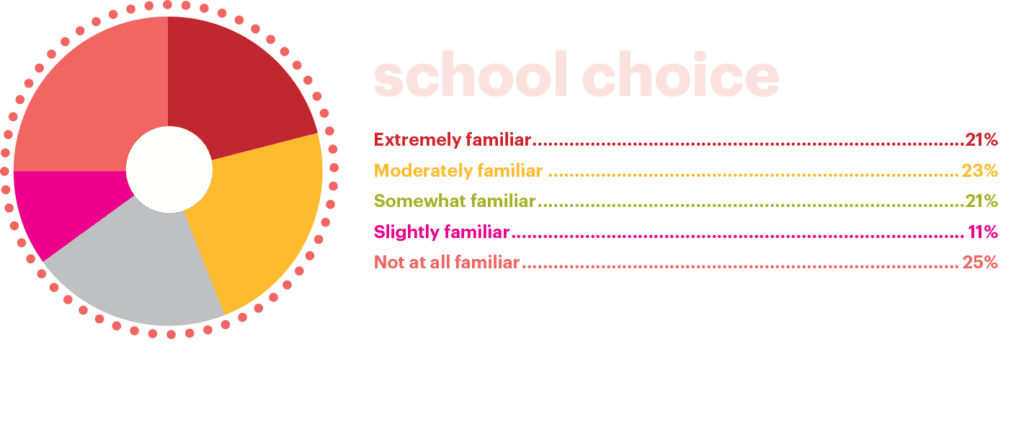
According to our survey, three-quarters of Hispanic and Latino parents had at least some familiarity with the term “school choice,” and more than one in five (21%) were extremely familiar.
However, one in five parents (20%) remained unsure of their school options, and 16% indicated that they did not have options. Additionally, Hispanic parents still faced challenges in navigating their options. 23% of “School Searchers” described the process of finding a school as somewhat or very challenging.
More than a third of “School Searchers” (39%) preferred more Spanish-language information about school choice.
When asked to describe in one sentence “why education is important to your family,” Hispanic families spoke up on education’s connection to opportunity.
According to survey respondents, family plays a central role in Hispanic households in the United States. For example, when selecting up to three words that most resonated from a list of ten, 84% of survey respondents chose “family.”
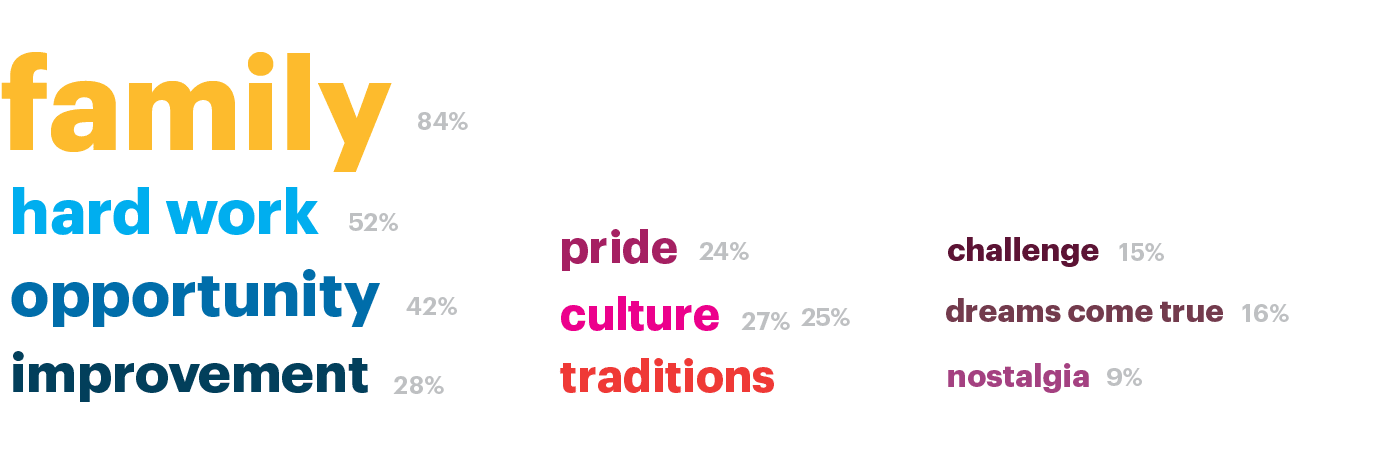
When parents were asked to describe why education is important to their family, answers included: “Education is the gateway to all things,” “Because through education you can live a better life,” “Because having an education opens up tons of opportunities to do whatever you want with your life,” “It gives my children a narrow path to escape poverty,” and “With education, many doors open and it is easier to find a good job and thus have a happier, more comfortable life.”
“Education is the great divide in which those with it lead more wholesome and reduced stress quality of life, and those without tend to live a limited and labor intensive lifestyle with stress and illness that can greatly reduce lifespan and mental wellness.” – Survey participant
If you’re a journalist covering education issues, contact Lucía Matamoros, Media Relations Coordinator, at [email protected].